
Clay Projected Versus Actual Release
A projected date is a calculation based on the sentence information and rules known at a given time. It can mark minimum eligibility, a presumptive parole target, conditional release, sentence expiration, or an agency’s calculated federal date. Those labels are not interchangeable. The actual release date records when the person physically left that custodian after staff cleared court orders, identity, credits, detainers, transport, and an acceptable release plan where required.
Clay County pretrial custody works differently. A person awaiting trial has not begun a fixed county sentence merely because a booking date appears. Bond may be paid, changed, or revoked. A judge may order recognizance release. Another warrant can intervene. The Sheriff also warns that permitted bond payment starts a multi-step process rather than an instant exit.
Find a Clay Projected Release Date
Do not subtract days from the booking date. Booking may precede sentencing, jail credit can start elsewhere, concurrent and consecutive matters may coexist, and a hold can stop physical release. Use a source chain that preserves those distinctions.
- Identify whether the person is pretrial, serving a county sentence, under MODOC, or in federal custody.
- Read the actual judgment, sentence date, and jail-credit entries in Missouri Case.net or the proper court record.
- For county custody, ask the Clay County Sheriff for the current calculation and all known holds.
- For a state sentence, use the MODOC active offender search, then review historical data or request the relevant fields.
- Ask the institutional parole officer about case-specific status, release planning, and Board action.
- For a federal sentence, read the BOP Release Date and Location together.
- After the date passes, obtain the actual release or transfer record.
The broader Clay County released inmate search and records path explains how to follow the person after a transfer or completed release.
MODOC Clay Release Date Fields
The MODOC public web search covers active offenders, including active probationers and parolees, and excludes discharged offenders. Its landing page does not promise the exact result labels or a public projected-date field. A CAPTCHA prevented reliable inspection of a suitable live record during research. The safe route is to use the portal for active status, then use MODOC’s published Sunshine data layout or a focused records request for sentence calculations.
The historical layout is unusually clear. Sentence-I Minimum Release Date is the calculated minimum on an active sentence. Sentence Maximum Release Date is the maximum release or expiration day for that sentence structure. A Completed Flag marks a completed sentence. The file has one row per charge, so the same person may appear more than once and each cause must be reconciled.
| MODOC item | Meaning | Limit |
|---|---|---|
| Minimum release date | Calculated minimum on an active sentence | Not an actual gate date |
| Maximum release date | Sentence maximum or expiration point | Other sentences or holds can matter |
| Presumptive parole date | Tentative Board-related target | Depends on conduct and an acceptable plan |
| Completed Flag | Published “Y” indicates sentence completion | Must be matched to each charge row |
| Sentinel code | Life, indeterminate, interstate, or assessment code | Never convert the code into a calendar date |
The MODOC Sunshine page shows the records custodians and data layouts.
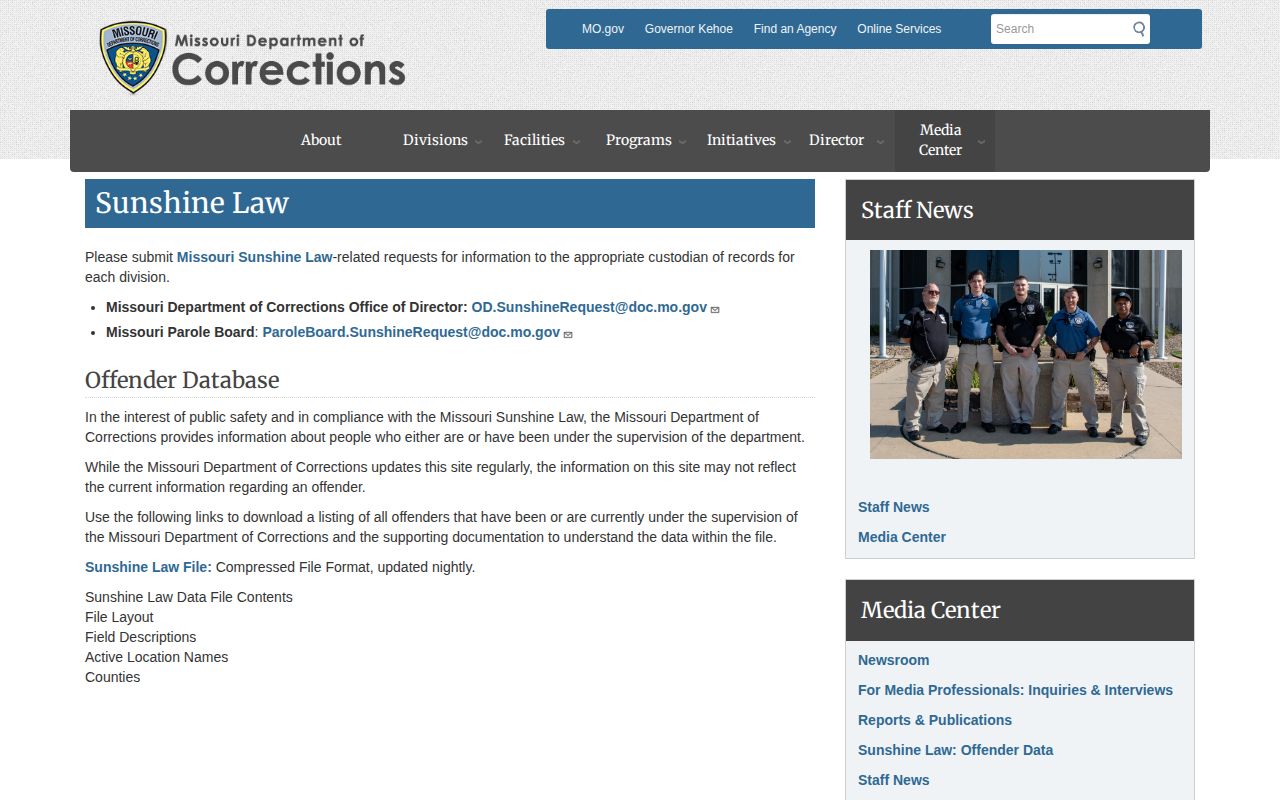
The published layout supports precise field requests, but a custodian or caseworker must explain the record for one person.
Missouri Rules for Clay Release Dates
Section 558.011 divides qualifying Missouri sentences into prison and conditional-release terms. For many non-dangerous felony structures, the conditional portion depends on sentence length. Institutional rule violations can extend the conditional-release date through the required process. Conditional release remains supervision by the Parole Board and is not final sentence discharge.
Section 558.019 establishes covered minimum prison terms. Prior MODOC commitments can produce minimum percentages under the statute. A dangerous felony generally carries the offense-specific eighty-five-percent rule or the statute’s age-and-service alternative. That rule is not universal. It must never be applied to every Missouri conviction or used without identifying the offense, sentence facts, and current law.
Section 217.690 gives the Parole Board discretionary authority under its standard and hearing rules. Eligibility does not force release. The Board warns that time-to-serve guidelines do not guarantee a date and may set a result above or below a suggested range.
Note: Missouri earned compliance credits under section 217.703 shorten eligible community supervision, not the prison or jail term before release.
Why Clay Release Dates Change
A correct calculation can change when the underlying facts change. Some changes affect eligibility. Others keep the date but prevent physical departure. Ask which category applies before treating a revised field as an error.
| Factor | Possible effect | Confirmation source |
|---|---|---|
| Institutional conduct | Conditional date can be extended under process | MODOC and disciplinary record |
| Credit recalculation | Minimum or maximum date can move | Agency sentence computation |
| Amended judgment | Sentence terms or credit can change | Court order and agency recalculation |
| Concurrent or consecutive ruling | Aggregate time can change | Judgments and MODOC record |
| Parole decision | A future date or later hearing may result | Missouri Parole Board record |
| Detainer, writ, or new case | Physical exit can become transfer or continued custody | Holding and receiving agencies |
| Release-plan issue | A tentative parole date can be delayed | Institutional parole officer |
Clay Minimum and Maximum Dates
Missouri’s paired minimum and maximum fields show why one “release date” label can mislead. The minimum field reflects the calculated low end on an active sentence. The maximum field reflects the sentence’s expiration structure. A presumptive parole date is tentative, and an actual exit is a separate event. Life and indeterminate codes add another reason to inspect the definition before reading eight digits as a date.
The Parole Board’s own guidance supplies the second half of this Clay County release-date check. Time-to-serve ranges guide rather than bind. A hearing can lead to another hearing in later years or a future date, and the official process says decisions commonly take weeks after the hearing. The Board record, sentence fields, and actual release record serve different purposes.
Federal Projected Dates from Clay
The BOP Inmate Locator covers federal custody, not the Clay County jail or MODOC. BOP labels a future date as its calculated projected release date. “UNKNOWN” can reflect pretrial, unsentenced, civil-commitment, or another indeterminate status. A past date combined with a released or no-facility location supports past BOP release, subject to BOP’s warning that another justice system or supervision may still apply.
A Clay County arrest does not itself establish a BOP record. USMS controls much federal pretrial custody and can house a federal prisoner in a local facility. In that stage, the federal docket and counsel may be more useful than BOP. After commitment, compare the federal judgment, BOP date, and location instead of importing a county jail estimate.
Request Clay County Date Records
A county sentence calculation is not published on the live Detention Listings page. Ask the Sheriff for the current calculation tied to the specific booking and judgment. Identify the person, case number, booking date, sentence date, and the information needed. Useful items include the sentence computation, credited custody days, scheduled completion date, release entry, and any transfer or detainer notation that can lawfully be released. The official detention-record address is shawna.smith@sheriffclayco.com. Electronic delivery and a cost estimate can be requested.
The judgment remains essential. Case.net may show the sentence and later orders, but the public docket is not a substitute for the Sheriff’s current computation. Ask the Clay County Circuit Clerk about a judgment or docketed order that is not available online. A municipal matter may use a different court route: Smithville cases now use Circuit Division 6, while Liberty and Gladstone retain municipal channels for their matters. The court that owns the case supplies the relevant order.
Missouri’s Sunshine framework also shapes the request. Section 610.023 requires timely action, which may be production, a reasoned delay notice, or a legal denial. It does not promise that a complex calculation arrives within three business days. Section 610.026 supports a cost estimate. The Sheriff publishes detention-record charges, but those county rates should not be copied onto a MODOC, court, or federal request.
A date record should be read with the release type. Completion of the stated county term does not clear another case, warrant, detainer, or transfer. If the written response names a destination, follow that receiving agency. If the actual exit has occurred, request the release timestamp and disposition rather than continuing to rely on a past projection.
Clay Parole Hearing Timing
The Missouri Parole Board publishes rules, hearing guidance, and time-to-serve material, but no public person-by-person hearing calendar or decision database was verified. For an individual schedule or decision, use Board Operations, the Parole Board Sunshine custodian, or the institutional parole officer. A hearing date is not a release date. The official process says an outcome may be another hearing in one to five years or a future release date, and a decision typically takes eight to twelve weeks after the hearing.
Even a future Board date remains conditional. Conduct, a suitable release plan, sentence restrictions, and other custody claims can affect the outcome. The institutional parole officer is the most direct case-specific source for a home plan or pending date. When community supervision begins, active MODOC status can remain visible because parole is not discharge.
Confirm a Clay County Release
Before the date, confirm the current calculation with the office that owns it. For Clay County custody, use the Sheriff and court. For MODOC, use the caseworker, field officer, or institutional parole officer. For federal custody, use BOP and the federal case. Ask about detainers or other holds without assuming the public field includes them.
MOVANS can provide a custody-change alert for participating Missouri systems, but notification data can lag and is not a certified release record. The Clay County VINELink and MOVANS check explains the current registration tracks. After the event, obtain the release sheet, transfer record, or receiving-agency confirmation. That final check turns a projection into a documented outcome.
Public Record Search
Sponsored Results